

Science Lesson: Exploring Mass and Heat Transfer
The energy that powers the cycling of matter on Earth has been transferred within Earth’s materials, moving from warmer substances to cooler substances. Students focus on the concept of heat transfer in this lesson, investigating how a substance’s mass affects how much its temperature changes over time.
Science Big Ideas
- Energy is transferred within Earth’s materials, moving from warmer matter to cooler matter.
- Heat transfer occurs because of the interactions between matter and energy, so the kind of matter in which energy is being transferred determines how quickly the heat transfer occurs.
Discover Complete Hands-on Screens-off Core Science Curriculum for K-8 Classrooms
Prepared hands-on materials, full year grade-specific curriculum, and personalized live professional development designed to support mastery of current state science standards.
Science Essential Questions
- Why is heat continuously flowing from Earth’s center outward?
- What happens when molecules in the outer core, warmed from the inner core, come into contact with molecules that make up the mantle?
- How does the mass of the mantle compare relative to the other layers of Earth?
- How would the rate of heat transfer via conduction change in a more massive substance compared to a less massive substance?
Common Science Misconceptions
 Misconception: Earth’s surface is constant and unchanging.
 Fact: Heat and pressure are constantly reshaping Earth’s surface.
Misconception: Geological processes happen in human time frames, and any change will happen within a person’s lifetime.
Fact: Many of the changes to Earth’s surface occur over thousands or millions of years. Other changes can be very rapid.
Science Vocabulary
Convection : heat transfer in fluids (liquids and gasses) where warmer, less-dense fluid rises, allowing cooler, denser fluid to take its place; causes a tumbling motion in the fluid
Radiation : heat transfer that occurs without contact between the heat source and the object heated
Lexile(R) Certified Non-Fiction Science Reading (Excerpt)
Energy Changes Earth’s Materials
Some of the energy that shapes Earth’s surface comes from deep within Earth’s interior. Earth is divided into four layers. The inner core is Earth’s hottest layer, and is made up of a mixture of solid iron and nickel. It is surrounded by an outer core that is made up of a less dense mixture of liquid nickel and iron.
Surrounding the inner and outer core is the mantle, which is mostly molten, semi-solid rock called magma. The mantle makes up almost two thirds of the Earth's volume (around 84 percent) and is about 2,900 km (1,802 miles) thick. Earth’s crust is the hard rock layer of the planet that supports the continents and oceans. The crust is Earth’s thinnest and coolest layer.
The mantle is in constant motion, powered by the transfer of energy between Earth’s warmer and cooler materials. Remember that heat is energy that has transferred whenever two substances are at different temperatures, and it always flows from faster-moving atoms (a higher temperature) to slower- moving atoms (a cooler temperature) until both substances reach the same temperature. Because of Earth’s structure, heat is continuously flowing from Earth’s center outward. Heat from Earth’s core warms the lower part of the mantle through conduction (heat transfer that occurs when molecules collide). When molecules of the mantle near the core are heated, their particles move faster.
As the particles move faster, they become more spread out and less dense than the cooler, upper mantle rocks, whose particles are much slower. The cooler particles clump together, becoming denser. The warmer rocks rise while the cooler rocks sink, creating slow currents within the mantle. This motion describes a form of heat transfer called convection.
Earth’s surface is fragmented into drifting slabs of solid rock, called tectonic plates. As magma moves beneath the crust, it pushes the tectonic plates toward or away from each other.
The tectonic plates are made up of Earth’s outermost 100 kilometers, made up of the crust and the coolest, strongest part of the upper mantle. This is called the lithosphere. The lithosphere floats on a zone of weak, melted rock called the asthenosphere. The places where Earth’s tectonic plates meet are called fault lines. The plates move extremely slowly, no more than a few centimeters a year, although the different plates move at varying speeds and in different directions. Scientists continue to study the complex behaviors of the plates.
Scientists know that as plates come into contact with each other, they transfer tremendous amounts of energy that cause various geological processes to happen at their boundaries. Their movements cause mountains, valleys, and oceans to form. These collisions between the plates are also the cause of earthquakes and volcanoes. Earthquakes are the shaking of the ground caused by a sudden release of energy when two tectonic plates suddenly slip past one another. When magma reaches the surface during an eruption, it is called lava.
The Cycling of Earth’s Materials
As the tectonic plates move, they change Earth’s surface and materials in different ways. For example, all of the rocks that are on Earth today are made of the same matter that existed when dinosaurs roamed. But rocks do not stay the same. The matter is reshaped and re-formed over millions of years into new rocks with different properties.
Most of the rocks found on Earth today started out as magma deep within Earth’s core. Over millions of years, the magma hardened, changed form, wore down, and re-formed into new kinds of rock. The processes that form, break down, and re-form rock from one category to another are called the rock cycle.
Heat and pressure are the primary causes of these changes. As far as 200 kilometers below the Earth’s surface, temperatures are hot enough to melt most rocks. It takes temperatures between 600 and 1,300 degrees Celsius (1,100 and 2,400 degrees Fahrenheit) to melt rock.
One category of rock is formed as a result of the tremendous heat and pressure of Earth’s interior. Metamorphic rocks are rocks formed in chemical reactions where one type of rock is changed by pressure or heat into a new type of rock with different properties. For example, the heat of Earth’s magma and the pressure of the rock layers above turn soft limestone into hard marble.
On the surface, energy from the sun is the primary source of change to rocks. The sun heats Earth through radiation, which is heat transfer that occurs without contact between the heat source and the object heated. Sunlight carries solar energy. When that energy reaches Earth, some of it is reflected back into space, some of it is absorbed by the molecules of the atmosphere, and the rest of the energy is absorbed by Earth’s surface (land and ocean) as thermal energy.
Changing temperatures cause water to change from a solid (ice) to a liquid and a gas (water vapor) and back again. For example, as water vapor cools off in the atmosphere and turns back into liquid water, gravity pulls that liquid water back to the surface as precipitation. All water on Earth’s surface also moves, pulled downward by the force of gravity.
When rocks on Earth’s surface are exposed to changes in temperature, wind, water or biological forces (such as plants or animals), they experience weathering. Weathering is the result of interactions among all of Earth’s systems. For example, one of the gasses in the atmosphere is carbon dioxide. When water falls to Earth’s surface as rain, it carries some of this carbon dioxide, making the water slightly acidic. This slightly acidic water causes chemical weathering of the rocks on Earth’s surface. Chemical weathering occurs when chemical reactions break down the bonds holding the rocks together, causing them to fall apart, forming smaller and smaller pieces. This is an interaction between the hydrosphere and the geosphere. The chemical weathering breaks down the rocks, transforming the matter into new substances with different properties, including salt and other minerals. Chemical weathering generally occurs gradually over time.
An Eruption Lasting More Than 30 Years
A result of all of these Earth processes is that Earth’s surface is constantly changing. Energy from Earth’s interior causes changes from within the planet, while energy from the sun powers changes on Earth’s surface
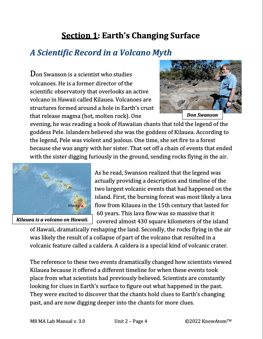
And these processes are continuous, which means that Earth’s surface will continue to change. Scientists study the processes to better understand the forces that shape the surface and to predict future changes. For example, scientists have set up a station that continuously monitors the eruption at Kilauea. Anyone can follow the changes to the volcano, and millions of tourists have joined scientists in watching the changes take place.
Scientists have learned that the ongoing eruption, which began in 1983, has added 500 acres of new land. This happens as the lava cools into igneous rock on the surface. They have also improved their understanding of how volcanoes work in general. From their perch, scientists watch the volcano itself change. For example, a new crater filled with a lake of lava was created in 2008.
Scientists are also studying what is happening beneath Earth’s surface. They are collecting a variety of different data, including changes in pressure to the magma beneath the volcano. They use that data to better understand the volcano as a system. Because of this, they have been able to improve their monitoring, such as predicting the path that lava will flow, similar to how scientists can predict upcoming floods.
Hands-on Science Activity
For the hands-on activity in this lesson, students develop a model to explore phenomena of how the mass of a substance affects the magnitude of its temperature change over time when thermal energy is added to the substance. Through this experiment, students figure out how matter and energy interact in the rock cycle, to analyze how thermal energy is transferred throughout Earth.
Science Assessments
KnowAtom incorporates formative and summative assessments designed to make students thinking visible for deeper student-centered learning.
- Vocabulary Check
- Lab Checkpoints
- Concept Check Assessment
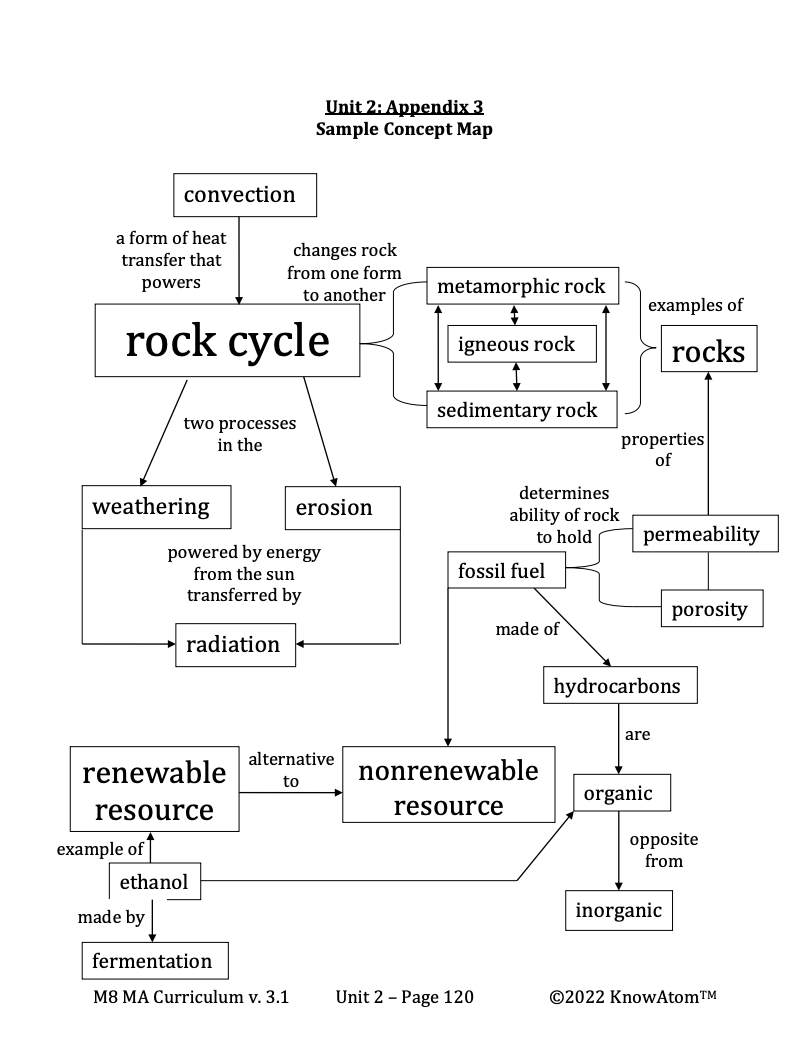
- Concept Map Assessment
- And More...
See How KnowAtom Aligns to NGSS Science Standards
Discover hands-on screens-off core science curriculum for student centered K-8 classrooms. KnowAtom supports classrooms with all hands-on materials, curriculum, and professional development to support mastery of the standards.
