---
title: Using Science Time-On-Learning Well
description: Under Next Generation Science Standards the expectations for time-on-learning need a second look.
image: https://www.knowatom.com/hubfs/Imported_Blog_Media/slide6-May-29-2024-07-53-32-0023-AM.png
---
[](https://cta-redirect.hubspot.com/cta/redirect/347944/f56bee57-133e-4975-8055-799f1f23588b)
[Teacher Login](https://app.knowatom.com/signin)
[](https://www.knowatom.com/)
x
[KnowAtom Feed](https://www.knowatom.com/blog/rss.xml)
# Using Science Time-On-Learning Well
Written by [Francis Vigeant ](https://www.knowatom.com/teaching-phenomena/author/francis-vigeant) | Dec 14, 2016 |
[Learning Methods](https://www.knowatom.com/teaching-phenomena/topic/learning-methods)
Using Science Time-On-Learning Well
5:10
While time-on-learning is an important element, you have to use it well in order to make a difference in student learning. That requires an intentional scope and sequence that is grade-specific. Each unit must support teachers through a carefully scaffolded series of units and lessons that builds on student understanding and is supported by the learning that came before.
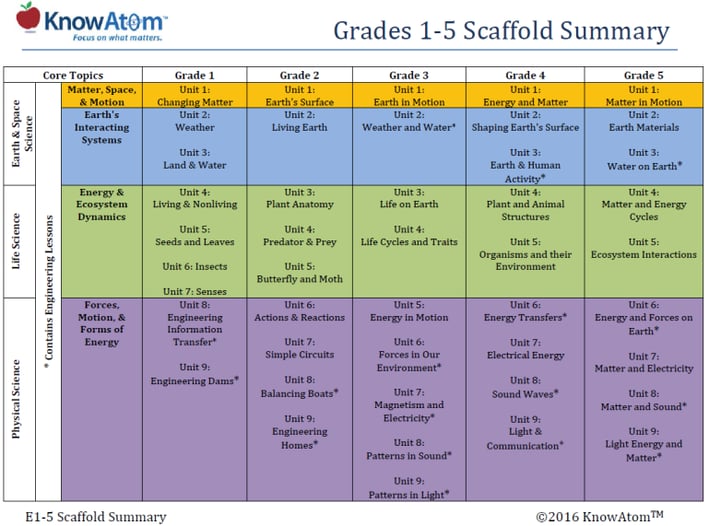 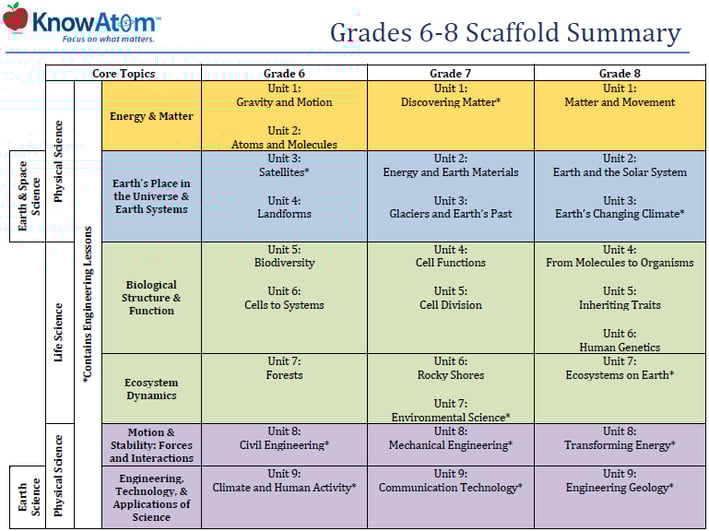
Our goal should be to intentionally nurture students both from September through June and from one grade level to the next, up into middle school and high school. That means the time-on-learning needs to be tight and well-spent so that you can get through each of nine units in a single year, readying students for the following year's challenges.
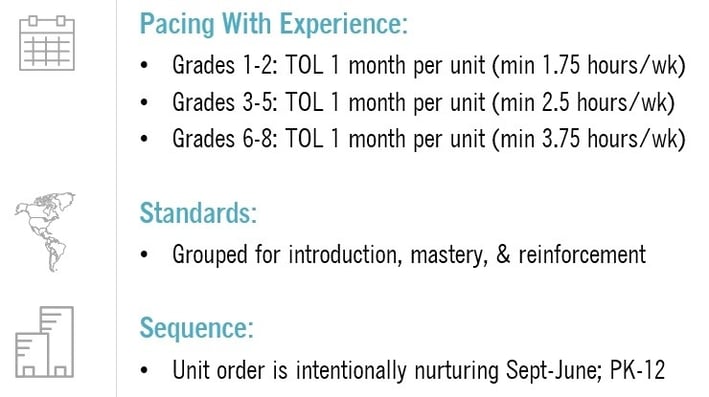
*Intentionally scaffolded units that support students in STEM learning from September to June and grade to grade must make very good use of time, sticking to a one-month-per-unit schedule.*
This is a significant change from the traditional three-unit-per-year model. Part of the problem with the old model—or trying to teach a full year of earth science in 6th grade and life science in 7th grade, and similar approaches—is that it creates a lack of momentum. There is no reason to move quickly through units when you have all year to work on a single subject. Moreover, students don't have a chance to learn and experience the connections between the disciplinary core ideas, which is key to crosscutting concepts. **We aren't creating an opportunity for students to see science and engineering as interrelated.**
Some educators express concern about the idea that we need to spend so much time on science and engineering, pointing out that a more realistic time allotment might be six weeks a year for three hours a week in K-5. To which we answer: *That's insufficient.* Unfortunately, with this kind of time-on-learning, you're only going to get through a third of what you need to get through. The important thing to realize is that level of time allocation not only fails students in the current year, but in all years that come after.
Consider [standardized testing](https://www.knowatom.com/teaching-phenomena/what-student-test-data-represents). A 4th or 5th grade standardized science test doesn't just test that grade; it actually tests *all* of the prior year standards. That's why students need to be set up, each and every year, to learn everything they need to succeed in the following year. Unfortunately, districts that offer such paltry time allotments to teachers typically see 20-40 percent proficient and advanced levels in their schools. That makes sense, because that's all you can really expect when you only address a third of the material needed to educate students on the subject at hand.
With this brief amount of time, it's also hard to build the momentum needed to master skills. Just as you get to that threshold where students can begin to master those skills, you disengage, transitioning away from STEM and to something else. Over the rest of the year, the skills students worked hard to earn will decay until the following year's teacher picks the material back up and begins teaching them again. But at that point, they might as well be starting cold. They might get slightly further than the last stopping place a year before, but that's about it.
To avoid this scenario, the teacher and district need to create an environment in which students are being challenged by and engaged in answering questions and solving problems **each week.** In so doing, they will develop the skills that will lead them to success in higher education and careers later on.
To foster development of those skills, the teacher needs to focus on science and engineering practices. The teacher does not say *how* those practices will be used to tackle questions and problems, nor how they will be used to engage with disciplinary core ideas. Rather, students in small teams will choose how to engage with the material, building their skills as they grapple with it on their own, with guidance from the teacher (a concept we will discuss further in a future blog post).
To accomplish this, students need time. If you're engaging in science only half the year and social studies the other half in a one-week-on, one-week-off model, you're going to be losing momentum every other week. That won't cut it. To nurture students all year long and [intentionally scaffold material](https://www.knowatom.com/teaching-phenomena/how-to-approach-creating-a-next-generation-classroom-from-kindergarten-on) so they can achieve mastery, students need a deep level of understanding and exposure to the subjects. Only then can they meet the performance expectations of the standards and demonstrate the evidence required.
If your school's or your classroom's schedule is currently structured in a way that creates stagnation rather than momentum, **it's time to change that.** Otherwise, teaching STEM effectively and meeting the performance expectations of the Next Generation Science Standards will be a losing battle. Changing expectations of what time-on-learning will look like is the only way to ensure students have the ability to act as true scientists and engineers.
[ ](https://www.knowatom.com/teaching-phenomena/author/francis-vigeant)
## [Francis Vigeant](https://www.knowatom.com/teaching-phenomena/author/francis-vigeant)
“Growing up, I wanted to be an inventor, solving problems that would help people have better lives. Every day at KnowAtom is an opportunity to invent solutions that give thousands of students and teachers a better experience doing science, engineering, technology, and math (STEM). Providing educators with professional satisfaction and students with the opportunity to understand the world we live in is my way of helping people have better lives.”
##### Sign Up for Our Blog
[](https://cta-redirect.hubspot.com/cta/redirect/347944/17a9319a-99ba-4386-9769-efb3e8bfcd3e)
### Posts by Topic
- [Teaching Tools & Strategies (72)](https://www.knowatom.com/teaching-phenomena/tag/teaching-tools-strategies)
- [Next Generation Science Standards (63)](https://www.knowatom.com/teaching-phenomena/tag/next-generation-science-standards)
- [Learning Methods (46)](https://www.knowatom.com/teaching-phenomena/tag/learning-methods)
- [STEM / STEAM (41)](https://www.knowatom.com/teaching-phenomena/tag/stem-steam)
- [Leadership (30)](https://www.knowatom.com/teaching-phenomena/tag/leadership)
- [Curriculum (23)](https://www.knowatom.com/teaching-phenomena/tag/curriculum)
- [State Standards (13)](https://www.knowatom.com/teaching-phenomena/tag/state-standards)
- [School Administration (11)](https://www.knowatom.com/teaching-phenomena/tag/school-administration)
- [Testing (11)](https://www.knowatom.com/teaching-phenomena/tag/testing)
- [Professional Development (8)](https://www.knowatom.com/teaching-phenomena/tag/professional-development)
- [Socratic dialogue (1)](https://www.knowatom.com/teaching-phenomena/tag/socratic-dialogue)
- [socracircle+ (1)](https://www.knowatom.com/teaching-phenomena/tag/socracircle)
[see all](https://www.knowatom.com/teaching-phenomena/using-science-time-on-learning-well#)
Related Posts
- [ Innovation in EdTech AI: SocraCircle+ and the](https://www.knowatom.com/teaching-phenomena/socracircle-and-the-power-of-human-connection)
- [ Cultures and Thinking in Action - Mindset 7:](https://www.knowatom.com/teaching-phenomena/learning-occurs-at-the-point-of-challenge)
- [ Learning and Thinking Are as Much a Collective](https://www.knowatom.com/teaching-phenomena/learning-and-thinking-as-a-collective-enterprise-mindset-6)
- [ Cultures of Thinking in Action Mindset 5:](https://www.knowatom.com/teaching-phenomena/learning-is-a-consequence-of-thinking-mindset-5)
- [ Cultures of Thinking in Action - Mindset 4:](https://www.knowatom.com/teaching-phenomena/students-learn-best-when-known-valued-respected-by-all-mindset-4)

Quick Links
Resources
Sign Up for Our Blog
### Sign Up for Our Blog
Connect with Us
-
-
-
-
© 2026 KnowAtom LLC • 10 Brady Drive Unit 3 • Ipswich MA • 01938 USA
[DO NOT SELL MY PERSONAL INFORMATION](https://www.knowatom.com/do-not-sell-my-personal-information) | [Privacy Policy](https://www.knowatom.com/privacy-policy) | [Terms of Use](https://www.knowatom.com/terms-of-use)
```json
{
"@context" : "https://schema.org",
"@type" : "BlogPosting",
"author" : {
"@type" : "Person",
"name" : "Francis Vigeant",
"url" : "https://www.knowatom.com/teaching-phenomena/author/francis-vigeant"
},
"dateModified" : "2025-05-14T19:42:28.294Z",
"datePublished" : "2016-12-14T05:00:00.000Z",
"headline" : "Using Science Time-On-Learning Well",
"image" : [ "https://www.knowatom.com/hubfs/Imported_Blog_Media/slide6-May-29-2024-07-53-32-0023-AM.png" ],
"mainEntityOfPage" : {
"@id" : "https://www.knowatom.com/teaching-phenomena/using-science-time-on-learning-well",
"@type" : "WebPage"
},
"publisher" : {
"@type" : "Organization",
"logo" : {
"@type" : "ImageObject",
"url" : "https://www.knowatom.com/hubfs/images/KnowAtom%20Logo.svg"
},
"name" : "KnowAtom, LLC"
}
}
```
```json
{
"@context" : "http://schema.org",
"@type" : "Organization",
"address" : {
"@type" : "PostalAddress",
"addressCountry" : "USA",
"addressLocality" : "Salem",
"addressRegion" : "MA",
"postalCode" : "01970",
"streetAddress" : "27 Congress Suite 410"
},
"alternateName" : "KA",
"areaServed" : {
"@type" : "GeoCircle",
"geoMidpoint" : {
"@type" : "GeoCoordinates",
"latitude" : "+42.5182274",
"longitude" : "-70.8877569"
},
"geoRadius" : "150 km"
},
"description" : "Next Generation Science STEM Curriculum",
"email" : "fvigeant@knowatom.com",
"image" : "https://www.knowatom.com/hubfs/KA-GSD.png",
"logo" : "https://www.knowatom.com/hubfs/Knowatom-2017/Image/logo-1.png",
"mainEntityOfPage" : {
"@id" : "https://www.knowatom.com/teaching-phenomena/using-science-time-on-learning-well",
"@type" : "WebPage",
"description" : "Under Next Generation Science Standards the expectations for time-on-learning need a second look."
},
"name" : "KnowAtom",
"sameAs" : [ "https://www.facebook.com/KnowAtom", "https://twitter.com/KnowAtom", "https://www.youtube.com/channel/UCS0rbN0RfqaU1xaISrdVpTA", "https://plus.google.com/110709105138117096940" ],
"telephone" : "(617) 475-3475",
"url" : "https://www.knowatom.com"
}
```