---
title: Understanding What the NGSS Are Asking For
description: The NGSS are performance expectations. They are not about recalling facts. It's important to keep this in mind when introducing them to your school.
image: https://www.knowatom.com/hubfs/ela-math-science.png
---
[](https://cta-redirect.hubspot.com/cta/redirect/347944/f56bee57-133e-4975-8055-799f1f23588b)
[Teacher Login](https://app.knowatom.com/signin)
[](https://www.knowatom.com/)
x
[KnowAtom Feed](https://www.knowatom.com/blog/rss.xml)
# Understanding What the NGSS Are Asking For
Written by [Francis Vigeant ](https://www.knowatom.com/teaching-phenomena/author/francis-vigeant) | Feb 22, 2016 |
[Next Generation Science Standards](https://www.knowatom.com/teaching-phenomena/topic/next-generation-science-standards)
If you want to avoid a [Next Generation Science Standards](https://www.knowatom.com/teaching-phenomena/9-things-you-should-know-about-next-generation-science-standards) showdown in your school or district, the first step you can take is to understand the design of the NGSS standards and, most important, that they are performance expectations. **They are categorically not about recalling facts.** Therefore it’s very important that you avoid adopting resources that label themselves “now next generation aligned,” “now next generation ready,” or any other euphemism meant to disguise resources based on the traditional model of science instruction.
#### This is crucial. Even if a resource is from a giant company, the recall-based model of instruction is simply not compatible with the next generation of [STEM](https://www.knowatom.com/teaching-phenomena/are-you-modeling-a-stem-mindset) instruction.
These types of resources do not encourage the higher order of thinking needed to create successful scientists and engineers in the workforce. They frequently do not emphasize the planning, experimenting and prototyping required to make STEM education vigorous, meaningful and contextualized.
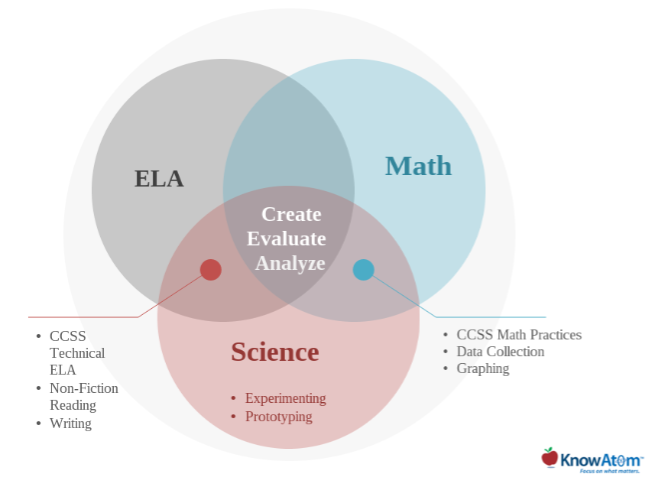
*Intentional use of these standards relies on higher-order thinking skills such as creating, evaluating and analyzing, as well as math and ELA standards. *
Keep in mind that by placing a focus on creation, evaluation and analysis occurring simultaneously in the classroom, we create a lot of value, not just for STEM subjects, but for math and [ELA Common Core](https://www.knowatom.com/teaching-phenomena/overlap-with-common-core-ela-math) subjects as well.
As a brief example, say, think about nonfiction reading and nonfiction writing as it relates to data collection and graphing. These both help inform science and engineering practices, but at the same time deepen students’ abilities in the realm of language and mathematics.
#### It's important that teachers, parents and other stakeholders understand that the Next Generation Science Standards are a context for this.
They provide a background and a canvas for science instruction, yes, but they also provide an environment in which [ELA](https://www.knowatom.com/teaching-phenomena/overlap-with-common-core-ela-math) and math, history, art and many other subjects can play out, with students as primary agents in learning. **Of course, that makes it even more important to be very upfront and clear that these Next Generation Science Standards prioritize creating, evaluating and analyzing simultaneously**, because if educators try to isolate practices in their instruction, they work against themselves. It's a pointless approach, and crucial to avoid.
## Avoid Adopting Something for Content-only Standards “Now Aligned”
As suggested above, many of the resources available on the market, even “updated” ones “aligned to” the Next Generation Science Standards, fail to place these abilities – creating, analyzing, evaluating – at the forefront, instead relying on older models of instruction. However, when teachers try to approach these practices without appropriate resources to back up the scientific processes and engineering design, they aren’t often very successful.
Imagine a driver's test that involves sitting in a parking lot and modeling the necessary driving process: hitting the brake ten times to model stopping, turning the wheel to the left ten times to model turning left. What is this driver’s test really testing, anyway? The fact that the student can repeat these actions does not prove they can make meaningful use of them on a city street. That’s not how you build a skill, nor how you assess it. **Instead, you need to scaffold these skills up and actually use the practices (braking, steering) together in a scaffolded environment. **
#### Keep in mind that the Next Generation Science Standards don’t tell you how to do that.
It’s not enough simply to have the standards on hand and hope that whatever curriculum you buy will do the trick, because the role of curriculum in linking standards together and connecting knowledge and practice is so crucial.
**The [curriculum](https://www.knowatom.com/teaching-phenomena/16-questions-you-should-always-ask-before-buying-a-stem-curriculum) has to be very thoughtfully created** so that it helps students truly meet the performance expectations the standard sets by using skills such as:
- Asking questions
- Deciding how to pursue an answer
- Developing a model
- Planning an investigation
- Gathering data
- Using data to analyze results
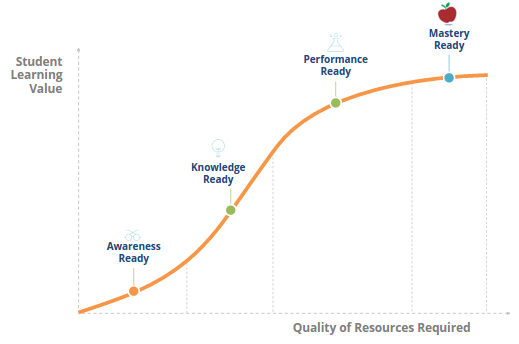
*Student readiness levels progress from a nascent awareness of a subject (awareness readiness) through competent understanding of that subject (knowledge readiness) to an ability to experiment with and inquire into a certain piece of content (performance readiness) to finally an ability to engage with these subjects in a huge variety of contexts (mastery readiness). *
The standards are fantastic, because they lend themselves to this progression. **Keep in mind that just as there are [different readiness levels](https://www.knowatom.com/teaching-phenomena/student-readiness-establishing-background-knowledge) of students, so too are there different readiness levels of resources.** A field trip to a museum and a downloadable worksheet about science are both awareness-ready resources. Textbooks that cover science and engineering are knowledge-ready resources. A performance-ready resource might be the mineral hardness kit, containing different rock samples that students can scratch and form conclusions.
None of these resources are bad, but you need resources that link them all together to encourage mastery readiness, in which **students transcend the content itself, and are able to look at it in a much broader context.**
A good example is contextualizing that mineral hardness kit through the lens of a contractor developing plans for and building a kitchen: Which material will be best for countertops? How should students sort through a variety of materials – wood, granite, marble and plastic – and decide which is best for the kitchen they’re constructing? How should they design tests to decide which is best; how should they carry them out? How do concepts such as melting, scratching and fracturing play in? What data can they use to inform their decision? In the end, what recommendation would they make to a contractor trying to answer these questions?
#### This is the type of thinking that will one day be required [in the real world](https://www.knowatom.com/pathways-to-stem-innovation-joshua-lederman-cornell-cuauv). That's mastery readiness.
[ ](https://www.knowatom.com/teaching-phenomena/author/francis-vigeant)
## [Francis Vigeant](https://www.knowatom.com/teaching-phenomena/author/francis-vigeant)
“Growing up, I wanted to be an inventor, solving problems that would help people have better lives. Every day at KnowAtom is an opportunity to invent solutions that give thousands of students and teachers a better experience doing science, engineering, technology, and math (STEM). Providing educators with professional satisfaction and students with the opportunity to understand the world we live in is my way of helping people have better lives.”
##### Sign Up for Our Blog
[](https://cta-redirect.hubspot.com/cta/redirect/347944/17a9319a-99ba-4386-9769-efb3e8bfcd3e)
### Posts by Topic
- [Teaching Tools & Strategies (72)](https://www.knowatom.com/teaching-phenomena/tag/teaching-tools-strategies)
- [Next Generation Science Standards (63)](https://www.knowatom.com/teaching-phenomena/tag/next-generation-science-standards)
- [Learning Methods (46)](https://www.knowatom.com/teaching-phenomena/tag/learning-methods)
- [STEM / STEAM (41)](https://www.knowatom.com/teaching-phenomena/tag/stem-steam)
- [Leadership (30)](https://www.knowatom.com/teaching-phenomena/tag/leadership)
- [Curriculum (23)](https://www.knowatom.com/teaching-phenomena/tag/curriculum)
- [State Standards (13)](https://www.knowatom.com/teaching-phenomena/tag/state-standards)
- [School Administration (11)](https://www.knowatom.com/teaching-phenomena/tag/school-administration)
- [Testing (11)](https://www.knowatom.com/teaching-phenomena/tag/testing)
- [Professional Development (8)](https://www.knowatom.com/teaching-phenomena/tag/professional-development)
- [Socratic dialogue (1)](https://www.knowatom.com/teaching-phenomena/tag/socratic-dialogue)
- [socracircle+ (1)](https://www.knowatom.com/teaching-phenomena/tag/socracircle)
[see all](https://www.knowatom.com/teaching-phenomena/understand-what-next-generation-science-requires#)
Related Posts
- [ Innovation in EdTech AI: SocraCircle+ and the](https://www.knowatom.com/teaching-phenomena/socracircle-and-the-power-of-human-connection)
- [ Cultures and Thinking in Action - Mindset 7:](https://www.knowatom.com/teaching-phenomena/learning-occurs-at-the-point-of-challenge)
- [ Learning and Thinking Are as Much a Collective](https://www.knowatom.com/teaching-phenomena/learning-and-thinking-as-a-collective-enterprise-mindset-6)
- [ Cultures of Thinking in Action Mindset 5:](https://www.knowatom.com/teaching-phenomena/learning-is-a-consequence-of-thinking-mindset-5)
- [ Cultures of Thinking in Action - Mindset 4:](https://www.knowatom.com/teaching-phenomena/students-learn-best-when-known-valued-respected-by-all-mindset-4)

Quick Links
Resources
Sign Up for Our Blog
### Sign Up for Our Blog
Connect with Us
-
-
-
-
© 2026 KnowAtom LLC • 10 Brady Drive Unit 3 • Ipswich MA • 01938 USA
[DO NOT SELL MY PERSONAL INFORMATION](https://www.knowatom.com/do-not-sell-my-personal-information) | [Privacy Policy](https://www.knowatom.com/privacy-policy) | [Terms of Use](https://www.knowatom.com/terms-of-use)
```json
{
"@context" : "https://schema.org",
"@type" : "BlogPosting",
"author" : {
"@type" : "Person",
"name" : "Francis Vigeant",
"url" : "https://www.knowatom.com/teaching-phenomena/author/francis-vigeant"
},
"dateModified" : "2024-06-26T07:25:55.434Z",
"datePublished" : "2016-02-22T07:22:00.000Z",
"headline" : "Understanding What the NGSS Are Asking For",
"image" : [ "https://www.knowatom.com/hubfs/ela-math-science.png" ],
"mainEntityOfPage" : {
"@id" : "https://www.knowatom.com/teaching-phenomena/understand-what-next-generation-science-requires",
"@type" : "WebPage"
},
"publisher" : {
"@type" : "Organization",
"logo" : {
"@type" : "ImageObject",
"url" : "https://www.knowatom.com/hubfs/images/KnowAtom%20Logo.svg"
},
"name" : "KnowAtom, LLC"
}
}
```
```json
{
"@context" : "http://schema.org",
"@type" : "Organization",
"address" : {
"@type" : "PostalAddress",
"addressCountry" : "USA",
"addressLocality" : "Salem",
"addressRegion" : "MA",
"postalCode" : "01970",
"streetAddress" : "27 Congress Suite 410"
},
"alternateName" : "KA",
"areaServed" : {
"@type" : "GeoCircle",
"geoMidpoint" : {
"@type" : "GeoCoordinates",
"latitude" : "+42.5182274",
"longitude" : "-70.8877569"
},
"geoRadius" : "150 km"
},
"description" : "Next Generation Science STEM Curriculum",
"email" : "fvigeant@knowatom.com",
"image" : "https://www.knowatom.com/hubfs/KA-GSD.png",
"logo" : "https://www.knowatom.com/hubfs/Knowatom-2017/Image/logo-1.png",
"mainEntityOfPage" : {
"@id" : "https://www.knowatom.com/teaching-phenomena/understand-what-next-generation-science-requires",
"@type" : "WebPage",
"description" : "The NGSS are performance expectations. They are not about recalling facts. It's important to keep this in mind when introducing them to your school."
},
"name" : "KnowAtom",
"sameAs" : [ "https://www.facebook.com/KnowAtom", "https://twitter.com/KnowAtom", "https://www.youtube.com/channel/UCS0rbN0RfqaU1xaISrdVpTA", "https://plus.google.com/110709105138117096940" ],
"telephone" : "(617) 475-3475",
"url" : "https://www.knowatom.com"
}
```