---
title: "The STEM Cycle: A Cycle of Innovation"
description: "It’s a question a lot of educators have: At their core, what are Next Generation Science Standards all about? The answer: It all boils down to the STEM cycle."
image: https://www.knowatom.com/hubfs/Imported_Blog_Media/STEM%201-425656-edited-May-29-2024-07-59-10-4667-AM.png
---
[](https://cta-redirect.hubspot.com/cta/redirect/347944/f56bee57-133e-4975-8055-799f1f23588b)
[Teacher Login](https://app.knowatom.com/signin)
[](https://www.knowatom.com/)
x
[KnowAtom Feed](https://www.knowatom.com/blog/rss.xml)
# The STEM Cycle: A Cycle of Innovation
Written by [Francis Vigeant ](https://www.knowatom.com/teaching-phenomena/author/francis-vigeant) | Apr 19, 2017 |
[STEM / STEAM](https://www.knowatom.com/teaching-phenomena/topic/stem-steam)
The STEM Cycle: A Cycle of Innovation
3:27
**It’s** **a question a lot of educators have: **At their core, what are [the Next Generation Science Standards](https://www.knowatom.com/teaching-phenomena/9-things-you-should-know-about-next-generation-science-standards) all about? Why do they exist? Why do we even need to consider changing our approach and methods?
**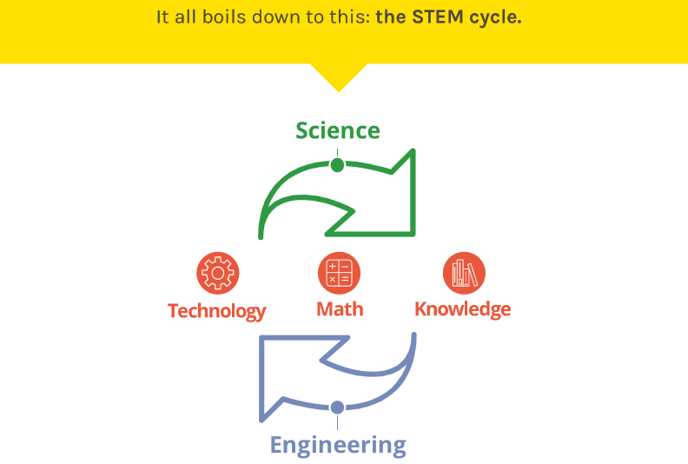**
In essence, **the STEM cycle explains why 100 percent of students must be exposed to STEM—because STEM skills are life skills. **Locked in the [STEM cycle](https://www.knowatom.com/teaching-phenomena/what-is-the-stem-cycle) are the seeds of critical thinking—creative, evaluative, and analytical thinking skills that are transferable and that make students trainable. These skills are the key to workforce development and the underpinnings of a student’s future college and career opportunities.
When we think about STEM as a cycle of innovation, we think about the relationships between science, technology, engineering and math. Those are the foundations of the Next Generation Science Standards, and the [foundation of innovation](https://www.knowatom.com/teaching-phenomena/the-ngss-as-a-hallmark-innovation-in-science-instruction) and revolution in the STEM industries beyond school.
**WHAT**** IS SCIENCE?**
The Next Generation Science Standards give us a solid definition of what science is: ***knowledge from experimentation. ***Scientists ask questions, then develop hypotheses and use experiments to test those hypotheses. The purpose of an experiment is to produce data that allow scientists to reflect on a hypothesis and ultimately see if it’s supported or not supported.
**WHAT IS ENGINEERING?**
Engineers solve problems using scientific knowledge. It’s worth noting, however, that a problem is not always something that’s electronic or physical, and engineering is not always about building a bridge, designing a wind turbine or constructing a wall—it’s broader. At its core, engineering is about solving a problem. The way you go about that is to identify and research the problem, survey the available materials, and then create prototypes to test. Engineers then use the data from those tests to determine whether a prototype does indeed create a solution to the problem.
**WHAT IS TECHNOLOGY?**
Software created in the Silicon Valley is technology: it solves problems. Spreadsheets and computers solve problems by enabling humans to store, transfer and convey data at fast rates and low costs. Aspirin and parking lot lines are also technology. Technology solves problems that directly or indirectly push society and innovation further, enabling scientists and engineers to ask questions and design experiments more frequently, more efficiently, and at whole new levels.
**WHERE DOES MATH BELONG IN STEM?**
As scientists or engineers go about their work, constructing procedures for testing their hypotheses or prototypes, those procedures need specific language. Math serves as a tool for communication and analysis, helping convey specific information, capturing specific measurements and analyzing data to understand the outcomes of testing. Math therefore is a tool for communication, replicating, and verifying the claims of others.
**This cycle applies to STEM in the K-12 classroom as well as careers. **When we look at the STEM cycle this way, we should be duplicating an environment like those engineers and scientists face in the real world— asking questions and solving problems. This means equipping students to be engineers and scientists by allowing them to create hypotheses, build prototypes, test, analyze, and then use math to quantify their outcomes and communicate that information to peers.
[ ](https://www.knowatom.com/teaching-phenomena/author/francis-vigeant)
## [Francis Vigeant](https://www.knowatom.com/teaching-phenomena/author/francis-vigeant)
“Growing up, I wanted to be an inventor, solving problems that would help people have better lives. Every day at KnowAtom is an opportunity to invent solutions that give thousands of students and teachers a better experience doing science, engineering, technology, and math (STEM). Providing educators with professional satisfaction and students with the opportunity to understand the world we live in is my way of helping people have better lives.”
##### Sign Up for Our Blog
[](https://cta-redirect.hubspot.com/cta/redirect/347944/17a9319a-99ba-4386-9769-efb3e8bfcd3e)
### Posts by Topic
- [Teaching Tools & Strategies (72)](https://www.knowatom.com/teaching-phenomena/tag/teaching-tools-strategies)
- [Next Generation Science Standards (63)](https://www.knowatom.com/teaching-phenomena/tag/next-generation-science-standards)
- [Learning Methods (46)](https://www.knowatom.com/teaching-phenomena/tag/learning-methods)
- [STEM / STEAM (41)](https://www.knowatom.com/teaching-phenomena/tag/stem-steam)
- [Leadership (30)](https://www.knowatom.com/teaching-phenomena/tag/leadership)
- [Curriculum (23)](https://www.knowatom.com/teaching-phenomena/tag/curriculum)
- [State Standards (13)](https://www.knowatom.com/teaching-phenomena/tag/state-standards)
- [School Administration (11)](https://www.knowatom.com/teaching-phenomena/tag/school-administration)
- [Testing (11)](https://www.knowatom.com/teaching-phenomena/tag/testing)
- [Professional Development (8)](https://www.knowatom.com/teaching-phenomena/tag/professional-development)
- [Socratic dialogue (1)](https://www.knowatom.com/teaching-phenomena/tag/socratic-dialogue)
- [socracircle+ (1)](https://www.knowatom.com/teaching-phenomena/tag/socracircle)
[see all](https://www.knowatom.com/teaching-phenomena/the-stem-cycle-a-cycle-of-innovation#)
Related Posts
- [ Innovation in EdTech AI: SocraCircle+ and the](https://www.knowatom.com/teaching-phenomena/socracircle-and-the-power-of-human-connection)
- [ Cultures and Thinking in Action - Mindset 7:](https://www.knowatom.com/teaching-phenomena/learning-occurs-at-the-point-of-challenge)
- [ Learning and Thinking Are as Much a Collective](https://www.knowatom.com/teaching-phenomena/learning-and-thinking-as-a-collective-enterprise-mindset-6)
- [ Cultures of Thinking in Action Mindset 5:](https://www.knowatom.com/teaching-phenomena/learning-is-a-consequence-of-thinking-mindset-5)
- [ Cultures of Thinking in Action - Mindset 4:](https://www.knowatom.com/teaching-phenomena/students-learn-best-when-known-valued-respected-by-all-mindset-4)

Quick Links
Resources
Sign Up for Our Blog
### Sign Up for Our Blog
Connect with Us
-
-
-
-
© 2026 KnowAtom LLC • 10 Brady Drive Unit 3 • Ipswich MA • 01938 USA
[DO NOT SELL MY PERSONAL INFORMATION](https://www.knowatom.com/do-not-sell-my-personal-information) | [Privacy Policy](https://www.knowatom.com/privacy-policy) | [Terms of Use](https://www.knowatom.com/terms-of-use)
```json
{
"@context" : "https://schema.org",
"@type" : "BlogPosting",
"author" : {
"@type" : "Person",
"name" : "Francis Vigeant",
"url" : "https://www.knowatom.com/teaching-phenomena/author/francis-vigeant"
},
"dateModified" : "2025-05-14T19:27:59.293Z",
"datePublished" : "2017-04-19T04:00:00.000Z",
"headline" : "The STEM Cycle: A Cycle of Innovation",
"image" : [ "https://www.knowatom.com/hubfs/Imported_Blog_Media/STEM%201-425656-edited-May-29-2024-07-59-10-4667-AM.png" ],
"mainEntityOfPage" : {
"@id" : "https://www.knowatom.com/teaching-phenomena/the-stem-cycle-a-cycle-of-innovation",
"@type" : "WebPage"
},
"publisher" : {
"@type" : "Organization",
"logo" : {
"@type" : "ImageObject",
"url" : "https://www.knowatom.com/hubfs/images/KnowAtom%20Logo.svg"
},
"name" : "KnowAtom, LLC"
}
}
```
```json
{
"@context" : "http://schema.org",
"@type" : "Organization",
"address" : {
"@type" : "PostalAddress",
"addressCountry" : "USA",
"addressLocality" : "Salem",
"addressRegion" : "MA",
"postalCode" : "01970",
"streetAddress" : "27 Congress Suite 410"
},
"alternateName" : "KA",
"areaServed" : {
"@type" : "GeoCircle",
"geoMidpoint" : {
"@type" : "GeoCoordinates",
"latitude" : "+42.5182274",
"longitude" : "-70.8877569"
},
"geoRadius" : "150 km"
},
"description" : "Next Generation Science STEM Curriculum",
"email" : "fvigeant@knowatom.com",
"image" : "https://www.knowatom.com/hubfs/KA-GSD.png",
"logo" : "https://www.knowatom.com/hubfs/Knowatom-2017/Image/logo-1.png",
"mainEntityOfPage" : {
"@id" : "https://www.knowatom.com/teaching-phenomena/the-stem-cycle-a-cycle-of-innovation",
"@type" : "WebPage",
"description" : "It’s a question a lot of educators have: At their core, what are Next Generation Science Standards all about? The answer: It all boils down to the STEM cycle."
},
"name" : "KnowAtom",
"sameAs" : [ "https://www.facebook.com/KnowAtom", "https://twitter.com/KnowAtom", "https://www.youtube.com/channel/UCS0rbN0RfqaU1xaISrdVpTA", "https://plus.google.com/110709105138117096940" ],
"telephone" : "(617) 475-3475",
"url" : "https://www.knowatom.com"
}
```