

Science Lesson: Understanding the Nervous System and Senses
In this lesson, students focus on the nervous system, exploring the phenomena of how different sensory receptors gather information from the environment and send information to the brain, which processes the information for immediate action or to be stored as memory.
Science Big Ideas
- The nervous system gathers information from the environment and processes it.
- The nervous system is an organ system because it is made up of groups of organs that closely interact together to carry out specific functions. It includes the brain, spinal cord, and nerve cells, also called neurons.
- The structure of the nervous system allows it to take in information through the senses, process the information, and then produce a reaction, such as making your muscles move or causing you to feel pain.
- Animals get information about the outside world through their senses.
- Human senses include sight, hearing, touch, taste, and smell, and humans gather information from the environment with structures called sensory receptors.
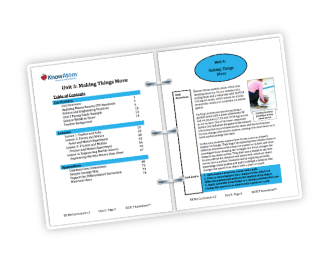
Discover Complete Hands-on Screens-off Core Science Curriculum for K-8 Classrooms
Prepared hands-on materials, full year grade-specific curriculum, and personalized live professional development designed to support mastery of current state science standards.
Science Essential Questions
- Why is the nervous system an organ system?
- How does the nervous system interact with all of the other organ systems?
- How do the sensory receptors gather information?
- What happens once a sensory receptor detects stimuli?
- What kinds of stimuli do our senses detect from the environment?
Common Science Misconceptions
 Misconception: Body systems are independent of one another, and so a change to one system won’t affect other systems.
 Fact: Each body system is made up of smaller parts, but the systems all interact with and depend on each other for the body to function properly.
Science Vocabulary
Brain : The part of the body that interprets all of the information the senses receive
Memory : The process of retaining information over time
Sense : How animals get information about the outside world
Sensory Receptor : A structure that is specialized to detect stimuli in the environment
Lexile(R) Certified Non-Fiction Science Reading (Excerpt)
Hearing Music as Colors
When Kaitlyn Hova hears music, she sees colors. Each note has a different color that she can physically see. This is because Kaitlyn has synesthesia (pronounced sin-uh s-thee-zhuh). Synesthesia is a condition that causes two or more senses to cross.
A sense is how animals get information about the outside world. Human senses include sight, hearing, touch, taste, and smell. People also have other senses, including the sense of balance, pain, and temperature changes. The nervous system takes in information through the senses. It processes the information and then produces a reaction, such as making your muscles move or causing you to feel pain. Sometimes the information is stored as memory. Memory is the process of retaining information over time.
Kinds of Receptors
There are different categories of receptors, depending on the kind of information they gather from the environment. Some sensory receptors respond to changes in temperature. These receptors are called thermoreceptors. Thermoreceptors are how you detect heat and cold.
Some receptors respond to chemicals in the environment. These receptors are called chemoreceptors. Taste and smell depend on these kinds of receptors.
In people, taste receptors are found in taste buds. Adults have about 3,000 taste buds, mostly on the tongue. When we eat, foods stimulate the taste receptors. There are at least four kinds of taste: sweet, sour, salty, and bitter. A fifth kind of taste, called umami, exists for certain kinds of food. It is sometimes described as savory. Taste buds for each of these tastes are found on the tongue. For example, the tip of the tongue is most sensitive to sweet tastes. The back part of the tongue is most sensitive to bitter tastes.
Taste buds generate nerve impulses based on the kinds of tastes in a particular food. Those nerve impulses are sent to the brain.
Sight
Other sensory receptors respond to light. These receptors are called photoreceptors. Light-sensitive cells in humans are located in the back of the eye. These photoreceptors are known as rods and cones. The cone cells are sensitive to color. The rod cells are responsible for peripheral and night vision. When light hits the eye’s rods and cones, the photoreceptors send signals through the optic nerve to the brain.
Like many animals, humans have two eyes. Our eyes have overlapping visual fields. This means that each eye looks at an object from a different angle. This is different from horses and rodents, which have eyes on opposite sides of their heads. The benefit to having overlapping visual fields is that we can see depth. This allows us to determine how far away objects are. Each eye views objects from a slightly different angle. The brain combines the information gathered from each eye to determine how far away the object is.
Crossed Senses in Synesthesia
Scientists are still exploring the causes of synesthesia. Some believe it happens when the pathway of sensory information from one sense gets crossed or merged with the pathway of sensory information from another sense.
So when Kaitlyn Hova hears music, the information taken in by her ears could perhaps get crossed with the part of her brain that receives information from her eyes, and associates the musical notes with different colors.
This is true of people who see numbers as colors. Scientists have used brain imaging to see what happens in the brain when exposed to black numbers on a white background. For people who don’t have synesthesia, only the part of their brain associated with numbers becomes active. However, when some people with synesthesia look at the same black numbers on a white background, the ‘color’ area of their brain also becomes active.
Hands-on Science Activity
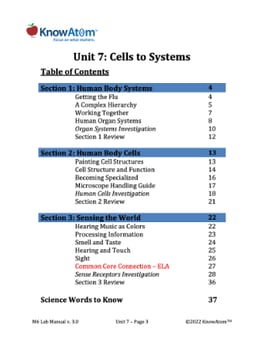
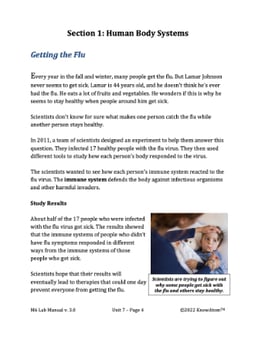
In this lesson students investigate how sense receptors for touch, smell, and sight respond to different inputs, transmitting them to the brain for immediate use or for storage as memories. In each investigation, students experiment with sensory data using their sense of touch, smell, and sight and then look for patterns in the data.
Science Assessments
KnowAtom incorporates formative and summative assessments designed to make students thinking visible for deeper student-centered learning.
- Vocabulary Check
- Lab Checkpoints
- Concept Check Assessment
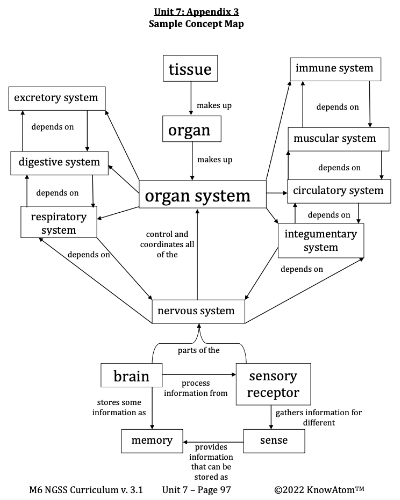
- Concept Map Assessment
- And More...
See How KnowAtom Aligns to NGSS Science Standards
Discover hands-on screens-off core science curriculum for student centered K-8 classrooms. KnowAtom supports classrooms with all hands-on materials, curriculum, and professional development to support mastery of the standards.
