

Science Lesson: Exploring Mass and Motion
In this lesson, students analyze how objects can transfer energy in a collision, tracing how energy changes from one form to another in an energy system and then exploring the relationship between an object’s mass and its speed.
Science Big Ideas
- Even though an object is stationary, it still has forces acting on it. Because the object’s motion isn’t changing, the forces acting on it must be balanced.
- The motion of an object can only change when the forces acting on it are unbalanced.
- The force needed to change an object’s motion is related to its mass. The greater the mass of the object, the greater the force needed to achieve the same change in motion.
- Rockets are technologies that apply Newton’s three laws of motion to get into space.
- Whenever two objects come into contact with one another, they exert a force on each other (action-reaction forces), and that force transfers energy from one object to the other.
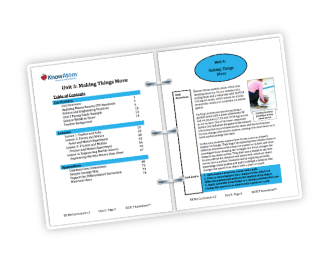
Discover Complete Hands-on Screens-off Core Science Curriculum for K-8 Classrooms
Prepared hands-on materials, full year grade-specific curriculum, and personalized live professional development designed to support mastery of current state science standards.
Science Essential Questions
- How could you describe the forces acting on a stationary object?
- What would have to happen to cause a stationary object to move?
- What is the relationship between forces and an object’s mass?
- How do rockets use action-reaction forces to move?
- How does the mass of a rocket affect its acceleration?
- How would you apply Newton’s first law to a rocket at rest on a launching pad to explain what has to happen to get the rocket in motion?
- Why won’t a rocket in motion on Earth continue to move forever?
- How does energy transfer in a collision?
- How are action-reaction forces related to energy transfer?
Common Science Misconceptions
 Misconception: Objects that aren’t in motion have no forces acting on them, and that is why they aren’t moving.
 Fact: Forces are acting everywhere in the universe all the time. When all of the forces acting on an object are balanced, the object won’t change its motion. This means that an object at rest will stay at rest, and an object in motion will stay in motion unless acted on by an unbalanced force. All changes in motion happen as a result of unbalanced forces.
Science Vocabulary
Energy : the ability to do work
Force : an action that changes or maintains he motion of an object
Momentum : the measurement of an object’s mass multiplied by its speed
Speed : the rate at which an object covers distance in a period of time
Lexile(R) Certified Non-Fiction Science Reading (Excerpt)
Forces and Motion
In order for a space rocket to be launched, it needs an unbalanced force to cause it to move. Unbalanced forces cause movement because they transfer energy into or out of objects or systems. Remember that energy is the ability to do work.
When an unbalanced force is applied to an object, energy transfers to that object. This transfer of energy changes the motion of the object. Imagine that a ball is sitting at the top of a hill. Because of its position on the hill, the ball has a form of potential energy called gravitational energy. Gravitational energy is the energy stored in an object as a result of its vertical position or height.
If someone comes along and pushes the ball, that person applies a force to the ball that transfers kinetic energy to the ball. The ball now has kinetic energy, which is what powers its movement from the top of the hill to the bottom of the hill.
If no other forces acted on the ball once it started moving, it would continue moving because of inertia. However, there are other forces acting on the ball that cause it to eventually slow down. For example, friction is a force that slows motion when two objects rub against each other.
Friction slows motion because it causes some of the energy of the moving object to change into heat. Friction is why your hands feel hot after you rub them together. Drag, also called air resistance, is similar to friction except that it occurs between a solid substance and a fluid such as air.
These same principles that caused the ball to move apply to rockets. Because of this, engineers launching rockets need to apply an unbalanced force on the rocket to cause it to begin to move. However, engineers also need to think about the mass of the rocket they are launching.
This takes us to Newton’s second law, which says that the amount of force needed to move an object any distance depends on its mass. It is written as an equation: “force = mass times acceleration.” Acceleration is an increase in speed over time. It is measured in meters per second squared (m/s2). Speed is the rate at which an object covers distance in a period of time. It is measured in meters per second (m/s). In other words, the more massive the rocket is, the more force will be required to change its motion and launch it into space.
Newton’s third law is the action-reaction law. This law states that for every action, there is an equal and opposite reaction. Action-reaction pairs occur whenever two objects come into contact with each other.
You are experiencing action-reaction forces right now. Remember that gravity is constantly pulling down on you. In reaction to the force of gravity pulling down, the ground has its own force that pushes back up with the same amount of force. This keeps you from sinking into the ground. If the ground did not push back with the same amount of force, you would fall into the ground. In this case, the forces would be unbalanced. Gravity would pull you down with a greater force than the force of the ground pushing back up.
A deflating balloon is another example of action-reaction forces. As the air escapes out the open end of the balloon, the force causes the rest of the balloon to move forward with an equal and opposite force.
Rockets are designed to move because of action-reaction forces. The rocket pushes combustion exhaust downward—the action. This is also called thrust. In reaction, the exhaust pushes the rocket upward.
Because of Newton’s second law, the greater the thrust, the more the rocket will accelerate upwards. Similarly, the more massive the rocket is, the more powerful the thrust will need to be. This is why the International Space Station couldn’t be launched after it was already built. There is no rocket that can produce a powerful enough thrust to get an object that massive into space.
Hands-on Science Activity
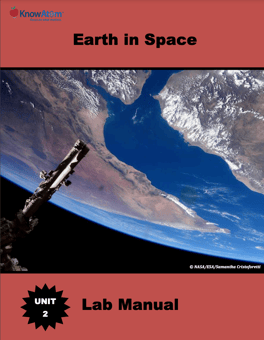
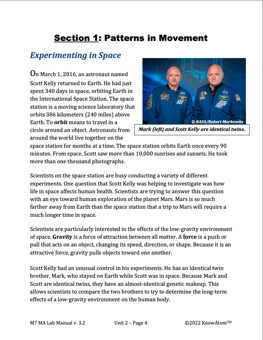
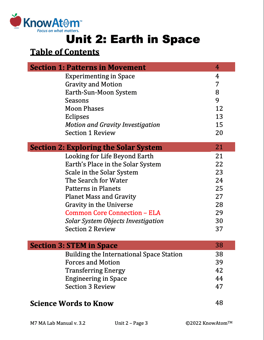
For the main hands-on activity of this lesson, students investigate the phenomena of how increasing the mass of a marble affects its average speed after a collision. Students collect and analyze data on the speed marbles of different masses travel after a collision, looking for patterns that might indicate a relationship between the mass of the marble and its resulting speed.
Science Assessments
KnowAtom incorporates formative and summative assessments designed to make students thinking visible for deeper student-centered learning.
- Vocabulary Check
- Lab Checkpoints
- Concept Check Assessment
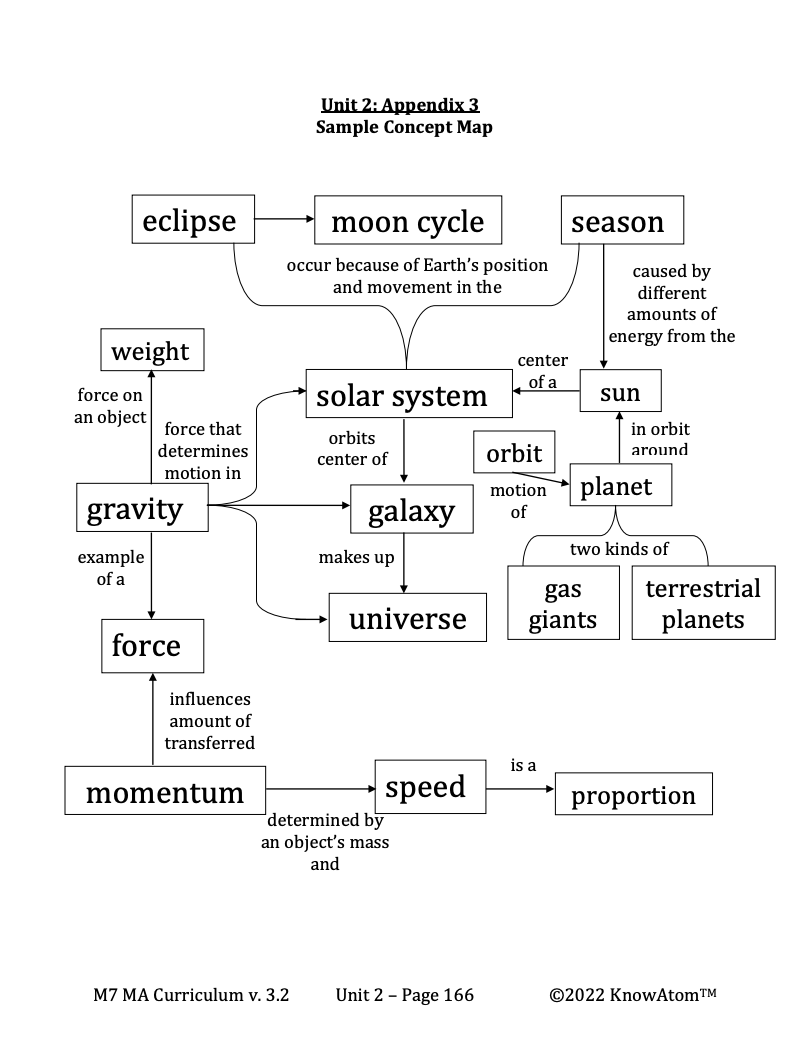
- Concept Map Assessment
- And More...
See How KnowAtom Aligns to NGSS Science Standards
Discover hands-on screens-off core science curriculum for student centered K-8 classrooms. KnowAtom supports classrooms with all hands-on materials, curriculum, and professional development to support mastery of the standards.
