

Science Lesson: Understanding the Scientific Process
In this brief intro lesson, students discuss how scientists ask questions and follow a process to get evidence-based answers to those questions.
Science Big Ideas
- Science is all knowledge gained from experiments. It is the search for explanations about the natural world, and scientists use evidence to form conclusions that support those explanations.
- Both science and engineering are part of the STEM cycle, which stands for science, technology, engineering, and math. They are connected and interact with one another, but they are also different.
- Scientists follow a scientific process that provides a systematic, logical framework for investigating the answers to their questions. A process is any series of steps designed to meet a goal.
- Data can reveal patterns that suggest relationships between variables in the experiment, including a cause-and- effect relationship.
Discover Complete Hands-on Screens-off Core Science Curriculum for K-8 Classrooms
Prepared hands-on materials, full year grade-specific curriculum, and personalized live professional development designed to support mastery of current state science standards.
Science Essential Questions
- What makes science different from other subjects, such as history?
- Why is evidence important in science, and how do scientists gather evidence?
- How are engineers different from scientists?
- What would happen if scientists tried to conduct an experiment without first asking a question?
- Why are data important in an experiment?
- What is a real-life example of a cause-and-effect relationship?
- How can patterns in the data indicate a cause-and-effect relationship?
Common Science Misconceptions
 Misconception: Science is not a process but rather a collection of facts.
 Fact: Scientists follow a series of steps called the scientific process to discover new knowledge.
Science Vocabulary
Cause and Effect : a relationship between events or things, where one is the result of the other
Data : the measurements and observations gathered from an experiment
Experiment : a specific procedure that tests if a hypothesis is true, false, or inconclusive
Hypothesis : a clear and concise statement that can be proved true or false
Pattern : something that happens in a regular and repeated way
Science : all knowledge gained from experiments
Scientist : a person who follows a scientific process to discover new knowledge
Lexile(R) Certified Non-Fiction Science Reading (Excerpt)
Questioning Phenomena
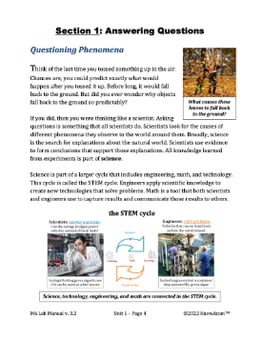
Think of the last time you tossed something up in the air. Chances are, you could predict exactly what would happen after you tossed it up. Before long, it would fall back to the ground. But did you ever wonder why objects fall back to the ground so predictably?
If you did, then you were thinking like a scientist. Asking questions is something that all scientists do. Scientists look for the causes of different phenomena they observe in the world around them. Broadly, science is the search for explanations about the natural world. Scientists use evidence to form conclusions that support those explanations. All knowledge learned from experiments is part of science.
Science is part of a larger cycle that includes engineering, math, and technology. This cycle is called the STEM cycle. Engineers apply scientific knowledge to create new technologies that solve problems. Math is a tool that both scientists and engineers use to capture results and communicate those results to others.
Using a Scientific Process
Scientists use a scientific process to guide them in developing a replicable experiment as they seek out answers to questions about the world around them. A process is a series of steps designed to meet a goal.
There are eight general steps that scientists often follow to answer questions using data from experiments. These steps give scientists a logical pathway to move from a question toward an evidence-based conclusion.
Step 1: Ask a question.
The scientific process always begins with a question. Scientists look for the causes of different phenomena they observe in the world around them. For example, Galileo Galilei was an Italian scholar in the 16th century who would become known as the father of scientific investigation and astronomy. He was fascinated by falling objects, and wondered whether different objects fall at different speeds. One question he asked was: “Do heavier objects fall faster than lighter objects?”
Step 2: Research the question.
Every year the amount of scientific knowledge grows. Scientists use this existing knowledge to research their question. They want to find out what is already known about their question.
Step 3: Form a hypothesis.
After scientists have researched their question, they form a hypothesis. A hypothesis is a clear and concise statement that can be proved true or false. The hypothesis is the scientist’s prediction, based on what is known, about the answer to the question.
Three example hypotheses are:
- “Heavier objects fall faster than lighter objects.”
- “Heavier objects fall more slowly than lighter objects.”
- “Heavier objects fall at the same speed as lighter objects.”
Step 4: Write a summary of the experiment.
Scientists then write a summary of the experiment they will conduct to test their hypothesis. The summary should include the basics of the data to be collected, the variables that will be tested, and the parts of the experiment that will remain constant in each test or trial.
Step 5: List materials and procedure.
Scientists then list materials needed and the procedure they have created that they will follow. A procedure is like a recipe. Whenever you use a recipe, you are following a careful and precise procedure that someone else developed. Scientists write down their materials and procedure so anyone can use the same materials and follow the same steps to get similar results. They also want to create a record of their thinking.
Step 6: Draw a scientific diagram.
They will also draw a scientific diagram. The diagram helps the scientists visualize how the different materials will interact in the experiment.
Step 7: Carry out experiments to collect data.
Scientists then conduct an experiment to test their hypothesis. An experiment is a specific procedure that tests if a hypothesis is true, false, or inconclusive. Galileo conducted multiple experiments to test the hypothesis that heavier objects fall faster than lighter objects. Measuring the motion of a falling object is difficult. This is because objects fall to the ground so quickly. Galileo realized that he needed to somehow slow down the motion of a falling object. He did this by rolling balls of different sizes down a wooden board that he inclined slightly from the ground. He thought that the balls would roll down the slope the same as if in a free fall, but more slowly.
The results of the experiment are data. Data are the measurements and observations gathered from an experiment. Scientists use experiments to look for patterns in data that suggest a cause- and-effect relationship, where one event or thing is the result of the other. A pattern is something that happens in a regular and repeated way.
Scientists design experiments in a specific way, with variables and constants. A variable is something you change. It can be a factor, trait, or condition that can exist in differing amounts or types. There are independent and dependent variables in an experiment.
An independent variable is the variable changed by the scientist. To ensure a fair trial, an experiment should only have one independent variable. The scientist changes the independent variable to observe what happens. For example, in Galileo’s inclined plane experiment, the size of the balls was the independent variable.
The dependent variable is what happens as a result of the independent variable. In Galileo’s experiment, the dependent variable was the acceleration of the balls as they moved down the ramp. Simply put, accelerations are changes in an object’s motion. Whenever an object speeds up, slows down, or changes direction, it accelerates. Galileo wanted to see if changing the mass of the balls (independent variable) caused their acceleration (dependent variable) to change.
During the experiment, the height of Galileo’s ramp was constant. A constant is a quantity that remains the same in an experiment. Constants allow scientists to isolate one variable at a time to ensure the experiment results are valid. If Galileo changed the height of the ramp during his experiment, he wouldn’t know whether the results were because of the size of the balls or the height of the ramp.
Step 8: Form a conclusion.
After data have been collected, scientists form a conclusion. The conclusion uses data from the experiment as evidence to support whether the hypothesis is true, false, or inconclusive. After conducting numerous experiments, Galileo concluded that gravity causes all falling objects, regardless of size, to accelerate toward Earth at the same rate.
Hands-on Science Activity
In this introductory lesson, students explore the scientific process as they set up their lab notebooks for this year’s science learning.
Science Assessments
KnowAtom incorporates formative and summative assessments designed to make students thinking visible for deeper student-centered learning.
- Vocabulary Check
- Lab Checkpoints
- Concept Check Assessment
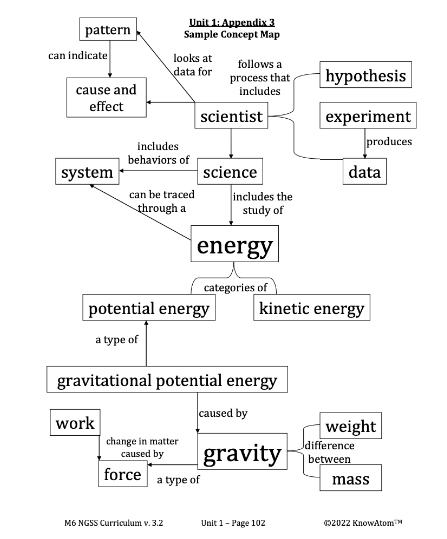
- Concept Map Assessment
- And More...
See How KnowAtom Aligns to NGSS Science Standards
Discover hands-on screens-off core science curriculum for student centered K-8 classrooms. KnowAtom supports classrooms with all hands-on materials, curriculum, and professional development to support mastery of the standards.
