---
title: How the Release of Responsibility Timeline Plays Into Science
description: Developing a NGSS science and engineering practices as student skills involves the release of responsibility.
image: https://www.knowatom.com/hubfs/Imported_Blog_Media/slide23-May-29-2024-07-58-17-6693-AM.jpg
---
[](https://cta-redirect.hubspot.com/cta/redirect/347944/f56bee57-133e-4975-8055-799f1f23588b)
[Teacher Login](https://app.knowatom.com/signin)
[](https://www.knowatom.com/)
x
[KnowAtom Feed](https://www.knowatom.com/blog/rss.xml)
# How the Release of Responsibility Timeline Plays Into Science
Written by [Francis Vigeant ](https://www.knowatom.com/teaching-phenomena/author/francis-vigeant) | Dec 28, 2016 |
[Teaching Tools & Strategies](https://www.knowatom.com/teaching-phenomena/topic/teaching-tools-strategies)
How the Release of Responsibility Timeline Plays Into Science
3:29
Thinking about things like the [release of responsibility](https://www.knowatom.com/teaching-phenomena/timeline-for-the-full-release-of-responsibility), you have to deploy materials in a streamlined, consistent fashion over the course of the year in all classrooms teaching the units. If you just split them up and let everybody test one thing at a time when they feel like it, the feedback you get will not be useful. It will be based on a collection of single experiences rather than a controlled sampling of data.
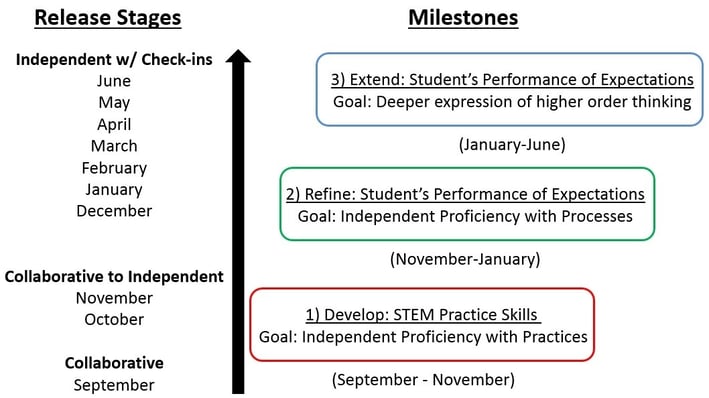
*The full release of responsibility happens in three stages, ensuring that students eventually develop the capacity to engage with material on their own for the majority of the year.*
Therefore, every classroom teacher has to prioritize following the specific stages that guide release of responsibility. This is defined by three distinct milestones, illustrated above. From September through November, the goal is to develop the STEM Practice Skills with the goal of independent proficiency with the practices. From then until January, the goal becomes refining students' performance of expectations with the goal of developing their independent proficiency with the science and engineering processes. Lastly, the teacher works toward extending the students' performance of the expectations with the goal of cultivating the [creative, evaluative and analytical thinking skills](https://www.knowatom.com/teaching-phenomena/success-higher-order-thinking-skills-and-grit) they will need later in life.
The three specific stages of release, on the other hand, are collaborative in September, collaborative to independent in October and November, and independent with check-ins from December through June.
If a district does not test materials in a consistent, reliable and replicable fashion, with a specific and dependable timeline for the release of responsibility, it will be difficult to get the kind of data needed to determine whether or not the curriculum meets the performance expectations set by Next Generation Science Standards.
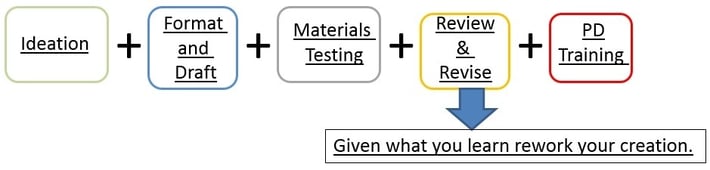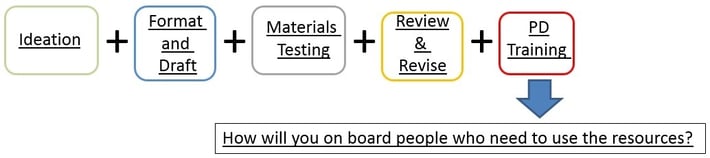
The review and revise phase involves taking what you've learned and reworking that creation to better meet NGSS standards. Lastly, professional development and training is taking what you've created and figuring out how you are going to deploy it to the rest of your district. It's important to make sure understanding and fidelity to the program exists across the board and to create mechanisms to receive continuous feedback throughout and across the years.
It's likely obvious by now that in order to create an effective curriculum, it's necessary to **grasp a range of elements simultaneously.** This includes how the three dimensions interact, how performance expectations are networked both horizontally and vertically and get turned into units, and how you create teams to address these needs from the [initial ideation period](https://www.knowatom.com/teaching-phenomena/next-gen-science-curriculum-development-process) to the final professional development training period. These requirements aren't going to be free, especially if you decide to design curriculum yourself.
Many educators want to leave the subject at that: It's going to cost too much money, so we shouldn't do it. The budget is tight already, et cetera, et cetera. But the truth is, if you look hard at what you're already spending and compare that realistically to what it costs to implement real STEM curriculum that helps students meet performance expectations, you can do the latter for less. This might seem unbelievable to districts embroiled in the age-old 7-year textbook cycle, but it's a fact, which we'll talk about in a future blog post.
[ ](https://www.knowatom.com/teaching-phenomena/author/francis-vigeant)
## [Francis Vigeant](https://www.knowatom.com/teaching-phenomena/author/francis-vigeant)
“Growing up, I wanted to be an inventor, solving problems that would help people have better lives. Every day at KnowAtom is an opportunity to invent solutions that give thousands of students and teachers a better experience doing science, engineering, technology, and math (STEM). Providing educators with professional satisfaction and students with the opportunity to understand the world we live in is my way of helping people have better lives.”
##### Sign Up for Our Blog
[](https://cta-redirect.hubspot.com/cta/redirect/347944/17a9319a-99ba-4386-9769-efb3e8bfcd3e)
### Posts by Topic
- [Teaching Tools & Strategies (72)](https://www.knowatom.com/teaching-phenomena/tag/teaching-tools-strategies)
- [Next Generation Science Standards (63)](https://www.knowatom.com/teaching-phenomena/tag/next-generation-science-standards)
- [Learning Methods (46)](https://www.knowatom.com/teaching-phenomena/tag/learning-methods)
- [STEM / STEAM (41)](https://www.knowatom.com/teaching-phenomena/tag/stem-steam)
- [Leadership (30)](https://www.knowatom.com/teaching-phenomena/tag/leadership)
- [Curriculum (23)](https://www.knowatom.com/teaching-phenomena/tag/curriculum)
- [State Standards (13)](https://www.knowatom.com/teaching-phenomena/tag/state-standards)
- [School Administration (11)](https://www.knowatom.com/teaching-phenomena/tag/school-administration)
- [Testing (11)](https://www.knowatom.com/teaching-phenomena/tag/testing)
- [Professional Development (8)](https://www.knowatom.com/teaching-phenomena/tag/professional-development)
- [Socratic dialogue (1)](https://www.knowatom.com/teaching-phenomena/tag/socratic-dialogue)
- [socracircle+ (1)](https://www.knowatom.com/teaching-phenomena/tag/socracircle)
[see all](https://www.knowatom.com/teaching-phenomena/how-the-release-of-responsibility-timeline-plays-into-science#)
Related Posts
- [ Innovation in EdTech AI: SocraCircle+ and the](https://www.knowatom.com/teaching-phenomena/socracircle-and-the-power-of-human-connection)
- [ Cultures and Thinking in Action - Mindset 7:](https://www.knowatom.com/teaching-phenomena/learning-occurs-at-the-point-of-challenge)
- [ Learning and Thinking Are as Much a Collective](https://www.knowatom.com/teaching-phenomena/learning-and-thinking-as-a-collective-enterprise-mindset-6)
- [ Cultures of Thinking in Action Mindset 5:](https://www.knowatom.com/teaching-phenomena/learning-is-a-consequence-of-thinking-mindset-5)
- [ Cultures of Thinking in Action - Mindset 4:](https://www.knowatom.com/teaching-phenomena/students-learn-best-when-known-valued-respected-by-all-mindset-4)

Quick Links
Resources
Sign Up for Our Blog
### Sign Up for Our Blog
Connect with Us
-
-
-
-
© 2026 KnowAtom LLC • 10 Brady Drive Unit 3 • Ipswich MA • 01938 USA
[DO NOT SELL MY PERSONAL INFORMATION](https://www.knowatom.com/do-not-sell-my-personal-information) | [Privacy Policy](https://www.knowatom.com/privacy-policy) | [Terms of Use](https://www.knowatom.com/terms-of-use)
```json
{
"@context" : "https://schema.org",
"@type" : "BlogPosting",
"author" : {
"@type" : "Person",
"name" : "Francis Vigeant",
"url" : "https://www.knowatom.com/teaching-phenomena/author/francis-vigeant"
},
"dateModified" : "2025-05-14T19:41:13.390Z",
"datePublished" : "2016-12-28T05:00:00.000Z",
"headline" : "How the Release of Responsibility Timeline Plays Into Science",
"image" : [ "https://www.knowatom.com/hubfs/Imported_Blog_Media/slide23-May-29-2024-07-58-17-6693-AM.jpg" ],
"mainEntityOfPage" : {
"@id" : "https://www.knowatom.com/teaching-phenomena/how-the-release-of-responsibility-timeline-plays-into-science",
"@type" : "WebPage"
},
"publisher" : {
"@type" : "Organization",
"logo" : {
"@type" : "ImageObject",
"url" : "https://www.knowatom.com/hubfs/images/KnowAtom%20Logo.svg"
},
"name" : "KnowAtom, LLC"
}
}
```
```json
{
"@context" : "http://schema.org",
"@type" : "Organization",
"address" : {
"@type" : "PostalAddress",
"addressCountry" : "USA",
"addressLocality" : "Salem",
"addressRegion" : "MA",
"postalCode" : "01970",
"streetAddress" : "27 Congress Suite 410"
},
"alternateName" : "KA",
"areaServed" : {
"@type" : "GeoCircle",
"geoMidpoint" : {
"@type" : "GeoCoordinates",
"latitude" : "+42.5182274",
"longitude" : "-70.8877569"
},
"geoRadius" : "150 km"
},
"description" : "Next Generation Science STEM Curriculum",
"email" : "fvigeant@knowatom.com",
"image" : "https://www.knowatom.com/hubfs/KA-GSD.png",
"logo" : "https://www.knowatom.com/hubfs/Knowatom-2017/Image/logo-1.png",
"mainEntityOfPage" : {
"@id" : "https://www.knowatom.com/teaching-phenomena/how-the-release-of-responsibility-timeline-plays-into-science",
"@type" : "WebPage",
"description" : "Developing a NGSS science and engineering practices as student skills involves the release of responsibility."
},
"name" : "KnowAtom",
"sameAs" : [ "https://www.facebook.com/KnowAtom", "https://twitter.com/KnowAtom", "https://www.youtube.com/channel/UCS0rbN0RfqaU1xaISrdVpTA", "https://plus.google.com/110709105138117096940" ],
"telephone" : "(617) 475-3475",
"url" : "https://www.knowatom.com"
}
```